
💎 Rejected 400 times in 4 months
I had to service clients for free. 400+ times. Before getting a single penny.
When I bootstrapped my first startup to $100k at 19, I had zero indication I could make it work. I never ran a company before. Had no clue wth “YC” even meant.
I wasn’t some genius math olympiad student. Never worked for a prestigious company. Wasn’t a domain expert.
So what advantage did I have?
1.) I had an immense tolerance for rejection
2.) Supported by two cofounders and life-long friends I admired (couldn’t have done it alone)
Those advantages have vanished. For the past year, I’ve been alone and reluctant to “try”. This post is dedicated to uncovering why I’ve remained “stuck” and “indecisive” in life – to an extent I almost feel embarrassed admitting.
At the end, I outline my plan for building a life that intersects with what I’m good at, what I’d enjoy, and could compound into long-term freedom.
The Hamster Wheel of Dougherty Valley High
I’ve never heard a toddler say: “Dad, can I enroll in a Python course and purchase Microsoft 365 for Christmas?”
In my neighbourhood, it was routine for parents to ask me if they should enroll their 8-year-old child in coding bootcamps.
(I’m being serious)
99% sure these kids would’ve spent their childhood doing literally anything else.
What we “naturally” wanted out of life got clouded by what was “practical”.
And nothing intensified that lifestyle for me like high school.
Like most Bay Area high schools, DVHS reinforced extreme competition. Either play the zero-sum game or get left behind
One classmate’s success at a top school came at the expense of another. Optimizing for prestige and competition crushes the need for “intrinsic motivation”.
Doing things for the sake of doing them would be a joke.
It’s not “strategic. It’s not “moving the needle”. It’s not “getting you ahead”.
“Well, I’m above this stupid rat race. I’m doing things because I love them”.
This mentality carried me through the first half of high school.
I did speech and debate because I loved the people. I’d look forward to staying back, talking to all the upperclassmen, and would be the last to go home.
With sports, I played basketball because dribbling brought me peace of mind.
I slowed down and watched Kyrie Irving dribble in 0.25 speed on YouTube, trying to copy his footwork, hip placement, and shoulder positioning.
Listening to one of his interviews, I wrapped a plastic bag around my ball to train my coordination, drilling myself to sleep in my own garage until my family told me I’m making too much noise for the neighbours.
Long term, I’m certain I made the right decision.
Everyone else will just suffer a midlife crisis, feeling empty and unfulfilled — wondering what exactly they’re “setting themselves up” for.
Defy the System, Pay the Price.
All my excitement for basketball washed away when my parents told me what every Bay Area brown kid hears at some point in their life: “This isn’t going to get you into Harvard”.
Debate also faded, for different reasons.
Competitions played a more important role in whether I’d be respected or not.
Look, in 10th grade, in every definition, I was an obnoxious class clown.
I deserved to be disciplined in my sophomore year.
But I wasn’t always knocked down for my impulsive behaviour.
During our leadership meetings, my coach requested some news about the placement of our club’s returning members: Novice, JV, Varsity
I chimed in, recognizing they were an old friend and claimed they were JV.
The response: “You’re barely varsity, why are you talking?”
The whole room erupted in laughter.
I sat in my chair, fighting back every urge to appear upset.
I couldn’t expect anyone to stand up for me: they had nothing to gain, and everything to lose
But I’d be lying back then if I wished the connections I poured so much effort into didn’t feel so invisible that evening.
I definitely fixated on the event more than anyone else. Most people probably moved on with their day and forgot it ever happened.
But I started pondering on the very question I had avoided so desperately: if I gained more success, maybe I wouldn’t be treated so poorly?
The fear intensified.
Junior year crept around.
The college admissions timeline started to get real, and everyone couldn’t stop talking about how stacked their applications were.
I procrastinated, had no clue what these summer programs were, and started scrambling for new activities.
“What summer programs did you get into? Did you get into YYGS?” “You didn’t even apply…?? Dude, you’re so cooked”.
Senior year stings.
Admission results came around: the people who played the system got the best results. I didn’t.
“You got into Georgetown, right? Isn’t that good for pre-law.. Wait, what exactly is American University… never heard of it”.
I was happy for my friends, but I sat alone, resenting the stubbornness that never seemed to get me anywhere.
The dream debate program I wanted to work at had to lay off some coaches, as enrollments were difficult to recover after the pandemic.
I hung on by a thread. However, my instructional hours, in particular, were cut in half. I was warmly welcomed, but overheard a few people joke around: “Didn’t he basically get half fired?”
In the moment, it’s not a big deal. It’s objectively true.
But time after time, these subtle events no longer felt like an accident in the eyes of my 18-year-old world.
It felt like a rude awakening: warmth didn’t earn respect. Competence did.
I gave up on resisting: that’s the system I’m playing under.
And I got fed up with losing.
Startups Became My “Glitch”
Maybe this is controversial, but most founders I know didn’t start a company to become happy. (The passion magnifies later, but not at the beginning)
Generally, the driving force comes from a void: craving importance, respect, and a feeling of significance. The business is merely a vehicle that helps them get there.
My experience in high school wasn’t intended to be a random sob story; it was the context for the raw, authentic truth, which pushed me through operating a company without any experience or certainty.
The excitement & passion followed, once our business model was validated, but it was originally spite that fueled me through the days when I couldn’t see if it would work.
I felt an enormous chip on my shoulder, in addition to feeling that I truly had nothing to lose.
If there was one advantage I developed over the years, it was cultivating the ability to do something for a prolonged period of time, without an immediate reward. In addition, I was also stubborn. I deeply wanted to understand why things worked (and why they didn’t).
I took a gamble to build a peer-to-peer mentorship ecosystem. The idea was simple: the most cracked 18-22-year-olds could steamroll the 40-year-old Harvard PhD career counsellors.
The incumbents looked good on paper, created strategies and timelines for their students, but had no domain expertise or any relatable context to help them execute. Why? Because they literally didn’t fight under the same competitive landscape as the students they were advising.
Collegiate was born, and I was responsible for bringing it to life.
I created my own frameworks to help students develop a personal brand. For application writing and internships, I wondered if there was a systematic way I could teach students to sound “more persuasive and interesting” on admission essays and cover letters for internships.
I interviewed my writing professors in college, and reconnected with my AP lang teacher in high school. I spent my summer break building my own curriculum and distributing lessons to an audience that gained millions of views on tiktok.
On the extracurricular front, we are experimenting with project-based learning cohorts to help students build tangible assets for their internships and long-term career goals — without kicking their interests down the gutter.
People built their dream projects and businesses in high school while getting accepted into top colleges. And most importantly, they didn’t hate working with us.
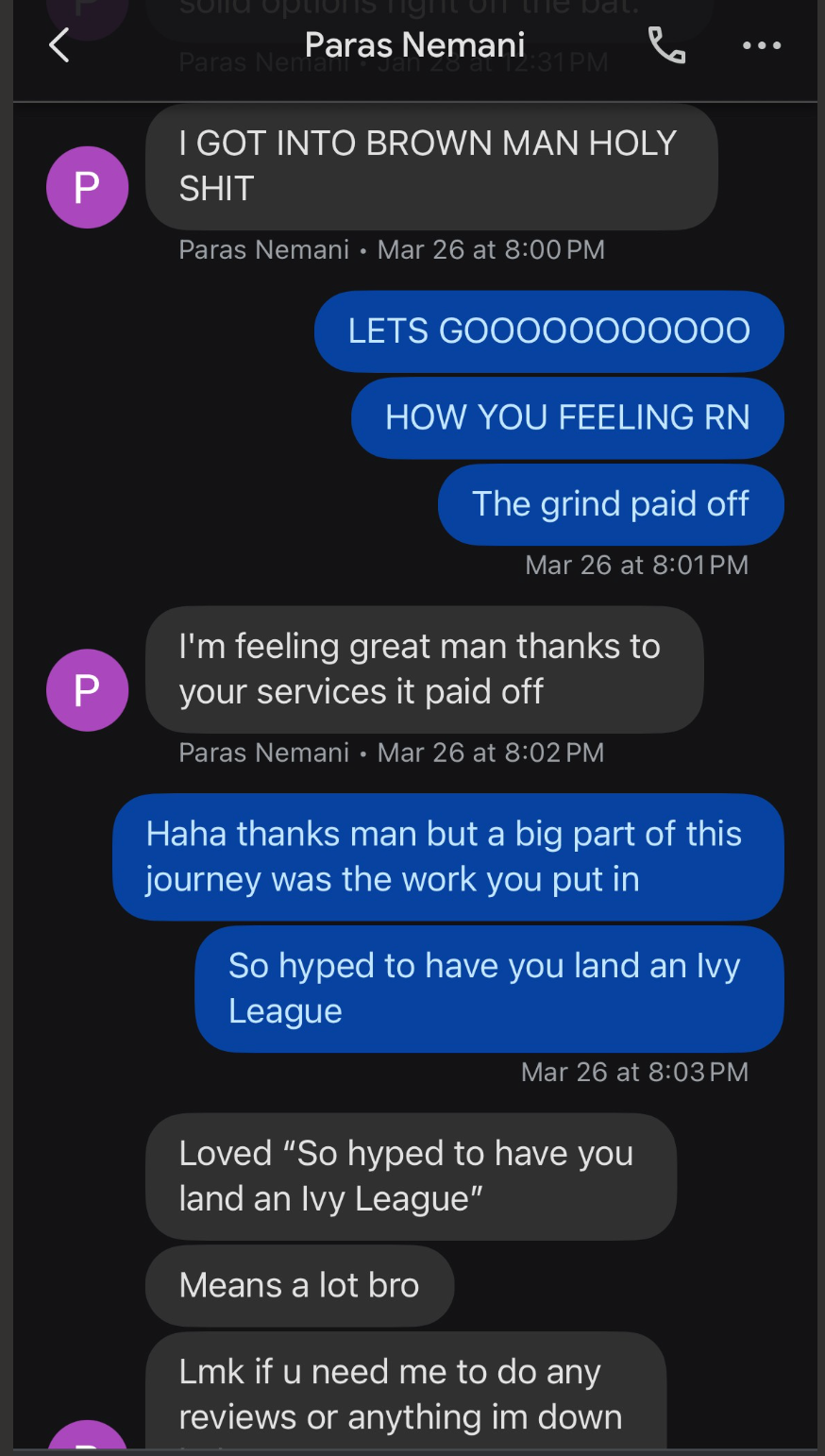
It was working. I saw the fruits of our own struggle begin to blossom for others.
Financially, I could close $5-10k in a few days, which would pale in comparison to any internship I could get.
Next year, we decided to scale and hire: our calendar was flooded with Harvard/MIT students. I was interviewing “the brightest minds” attending the brightest schools.”
My world flipped upside down in less than a year.
The progress was exponential. Entrepreneurship felt a genuine glitch.
I turned the system on its head and started winning on my terms.
Lvl. 100 Mafia Boss → Lvl 1. Crook
After shutting down the business (explained why in a previous post) and the graduation timeline looming around the corner, I had to start thinking about “being practical” again.
“Maybe I'll work at McKinsey for 2 years, or work at a high-growth startup until I’m ready”.
I lost the same conviction I once had.
I no longer had the support of my cofounders to lean on. The problem I also solved was perfectly aligned with my own, intimate struggles with the early career ecosystem.
It was time for me to rebuild from scratch.
Once you're delusional enough to start a company the first time, you become acutely aware of where things go wrong, before they go right.
Restarting felt like it would take longer, not shorter.
The desire to escape an unfulfilling future, but lacking the capability to do so, haunted me.
SF Tech Twitter Lied To Me – “High-Agency” is Not Enough.
Everyone told me the benefits of becoming a “self-starter"; no one mentioned the costs.
Skills demand consistency.
Consistency demands commitment.
Commitment demands conviction.
But finding conviction isn’t so simple.
Judgement on “what to work on” is more important than “working” with a blindfold on.
And it’s never been easier to mistake activity for progress.
Most founders I’ve personally met across the Harvard/SF hacker houses have admitted to this very problem…
If you over-index on agency, you’re probably just going to try a bunch of random things, get frustrated, and tell yourself, “ oh, it's just not meant for me”.
Finally, you pick up something that catches your interest again and repeat the cycle. (Believe me, I’ve been there, and still get stuck to this day).
You ship a couple of features, but nobody buys from you.
So, as the high agency person you are, you start posting a bunch of content online. Make 50 IG reels, write a couple of LinkedIn posts, but your following count stagnates. Time to burn a few hundred bucks on Facebook ads?
Finally, you get a sales call booked, and get hit with the classic: “I need to think about it”. Oh, of course, let me be polite and give them space.. I’m sure they’ll get back to me. Turns out your prospect needed to “think about it” indefinitely, and you have no idea why you fumbled discovery.
You have no clue why people aren’t engaging with your marketing. Maybe your landing page has an unclear CTA? Whenever you do get an inbound call, you don’t know why your customers are giving you objections. Is your offer too complicated? Did you mirror their energy or come off way too aggressive?
Now you beg an LLM for help, and your output is averaged out based on the context it has across all the data sources it’s pulling from.
However, an account executive who’s closed over 10,000 deals knows what triggers, tonality, positioning, and timing will cause another *human to buy from them.
There is a layer of intuition that can only be built by commitment, not initiative.
That comes from resisting new opportunities, establishing clear feedback loops so you’re not shouting into an empty void, and having faith in repetition.
Taking initiative has never been easier. Starting new stuff is cheap.
Sticking to the “right” stuff is rare.
Agency helped me start the race, but never taught me how to reach the finish line.
Easier Said Than Done.
“Maybe I just have ADHD”.
No. My head was just full of open loops that never got closed. I tossed and turned at night because, subconsciously, the weight of all my expectations became too heavy.
The conventional self-help advice instructed me to take small steps. But the world is not moving in small steps.
Everyone seems to be raising millions in venture funding, can code faster than me, write better copy, close higher-ticket deals, and I’m still scrambling to find my footing.
The barrier to entry for new grads seems to keep rising. Expectations keep rising.
Taking tiny actions isn’t intuitive when I’m conditioned to seek quantum leaps of improvement.
My ego pushes back, asking why I wasn’t good enough. Why couldn’t I keep up? Why can’t I go faster? Why can’t I outcompete everyone?
I’m afraid of hitting a ceiling, because I’m reminded since childhood how worthless I felt when I couldn’t “achieve mastery” or be “competitive” at everything I did.
Why am I so obsessed with choosing a skillset that makes me great?
When I did what I loved, and it didn’t intersect with something that made me exceptional, I was treated like a useless pushover.
Hard to feel content when you get curbstomped to the floor and can’t fend for yourself.
Competence was a prerequisite to fulfillment.
I hold this view, no longer out of spite, but from acceptance of rising to my potential.
The Market Remains Insolvent Longer than You’re Correct
Even if you’re betting against the AI trade, the tangible impact of layoffs for junior workers is occurring. Right now.
Worst of all, there isn’t a magical blueprint on how to “future-proof” yourself.
Doesn’t matter if Sam Altman believes AGI takes over, or if Michael Burry claims the entire ecosystem is a house of cards. If you believe the AI race is overhyped, what happens when you’re wrong?
If you correctly identify the trend, how do you curate an advantage?
There isn’t an institutional authority that has the perfect answer.
They’re simply making bets at the end of the day.
If you don’t define your own, others will impose their strategy on you.
I have a friend working in tech banking, where they restrict the use of general-purpose LLMs to protect client confidentiality.
The AI media would say they’re “falling behind” on the latest technology.
Conversely, I’ve had friends working in big tech, pressured by their manager to burn a minimum AI credit threshold – or else they literally get fired.
MIT reports will claim these workers are most prone to burnout and atrophying their critical thinking skills.
Appeasement Will Drive You Insane.
Work at a big company – cog in the machine
Work at a startup – too scared to start your own
Start your own company – scammer
Always working – boring
Become well-rounded – mediocre at everything
Focus on one thing – unbalanced
Do the bare minimum at work – self-entitled and lazy
Try in school – textbook thinker
Try your own business – unqualified
….
Either I gain conviction, or remain at the mercy of everyone’s judgment.
Active Investors Manage Risk, Why Shouldn’t I?
The only way to escape an imperfect, high-risk environment is to start managing it effectively, rather than running away from it.
I had to transition from being a paralyzed, passive decision-maker to placing active bets on how I’m positioning my future.
I. Momentum Investors
The NVIDIA, Sandisk, and Micron glazers. Look at what’s “doing hot”, and buy more of it.
Viewing momentum from a career standpoint is pretty appealing. You can catch the current, in-demand skills, but risk rushing into an overcrowded market.
It’s one of the few competitive advantages that young people will continue to have in their early 20’s.
My generation grew alongside ChatGPT, Instagram and TikTok.
The new “corporate storytelling role” paid multiple 6-figures because the bald, 60-yr old oad room directors had no idea how to appeal to Gen-Z.
For me, the “momentum” skill I’m adding to my toolkit is GTM engineering & rev op automations (even though I believe it’s significantly overvalued).
I met with a founding AE who scaled a unicorn startup, and he explained that everyone in SF is paying a crazy premium for people leveraging AI automations on signal scraping and multi-step outbound sequencing.
(even though he also believes it’s not moving the needle long-term in tech sales)
Some skills will just catch hype. Going with “what’s hot” might be the easiest way to generate short-term cash flow if you're unsure about what will stick around long-term.
II. Contrarian Value
If you remain a trend chaser, you risk never building anything that significant. Something that lasts. Forever at the mercy of copying what other people tell you works, instead of “making it” work.
There are a few people I know who have successfully pulled this off, one of whom is my good friend Noah Jacobs.
He willed his startup (Birddog) into existence by taking a contrarian bet against the LLM and agentic AI craze in the sales intelligence space.
The cost functions just didn’t make sense to scale, but everyone told him his scraper was going nowhere, and he needed to go trigger-happy with agentic AI.
A year later, a team with one engineer starts talking to customers from enterprises with over 100.
When looking to emulate my own, high-conviction viewpoint, I initially sought something that appeared “technical”.
My dominant aptitude seemed to revolve around sales, persuasion, and writing, but I rejected it. I felt guilty for banking on something that appeared to be a “soft skill”.
The Bay Area has a dominant engineering culture: I was conditioned to believe walking down this path wouldn’t make me “intelligent”.
*Intelligent people can make dumb decisions
If a quant trader working at Citadel hated their life, are they considered smart?
Their intelligence made them world-class at math problems.
But dug a grave for their life problems.
There are two high-level issues:
- Figuring out what’s *worth getting
- Figuring out how to get it
By default, I’ve been praised for my ability to achieve difficult things – instead of questioning why I went after them.
I stubbornly told myself I should learn how to code. But the desire only emerged out of fear.
I never set a goal outlining how I’d learn it, and more importantly, why I’d do it.
It just seemed like the right thing to do, because everyone else in high school said they were.
It’s something other people had, that I didn’t.
I wasn’t “technical”. They were.
They appeared competent. I didn’t.
Hypothetically, I could punch a wall to prove I’m not weak.
But then again, who am I really trying to impress?
Back to the Point.
The one skill I’m banking on, that I will continuously compound on (even if others tell me I’m wasting my time) is writing.
I can really only see two skills that can scale to produce freedom: coding and writing. Specifically, digital writing, long-form content, and newsletters.
Advertising is writing. “Posting on social media” requires writing a script. A sales script is also writing.
Other skills to produce a high income definitely exist, but fall under the classic “time-for-money” tradeoff.
A million users can log into an app or view a media that can convert into revenue, in my sleep.
(This is the end state, which I obviously haven’t reached).
“Why are you wasting your time in a random coffee shop, on a random Saturday noon?”.
Because I’m learning to think more clearly and become as persuasive as possible. Finding ways to spot my internal contradictions, relate them to someone else’s emotional and psychographic state, connect with their pain, reframe a new identity, and build trust through written word.
That trickles downstream in my ability to build trust through verbal communication.
If I’m targeting tech sales for immediate cash flow, investing long-term in honing my writing skills will keep compounding. Whether it’s for my current job, or building my own business, I’ll need to produce a content engine to acquire customers at scale.
Trust is the new currency that every company is desperate to access in a world poisoned by AI slop.
Outbound is losing relevance.
Buyers aren’t stupid. They’re skeptical.And the bar will keep rising.
These blogs are my training ground to prepare for the boardroom.
III. Liquidity
Hard to make large investments when you're illiquid.
These are day-to-day, maintenance tasks – such as Canvas assignments, HW, and exam prep.
Or even getting food, cleaning my room, and doing laundry.
I used to dread it all. When I’m obsessed with gaining leverage, these feel like monotonous obstacles, chipping away at all the progress I could be creating for my life.
But I took time to internalize the consequences of ignoring these “low-leverage” activities. Leaving a messy room unaddressed mentally keeps me from getting anything done.
I organized each task within a comprehensive “skills” framework, such as reading comprehension, consistency, or executional proficiency.
Homework, cooking, or cleaning feels less like a clash and waste of time.
My energy is better preserved, and I’m not always feeling bitter for doing things that should be keeping my life afloat.
Expanding my view of what “progress” is supposed to look and feel like was essential.
Before I could start moving forward, I needed to figure out what it even meant.
IV. Hedging
Placing two opposing bets protects you from the downside of either outcome.
I’m preparing for a 2+2 Deferred MBA program (targeting Stanford/Harvard/Columbia). If I get my standardized exam prep done before I graduate, the risk calculus I can now take changes aggressively.
Taking an AE role without ever working a full-time job, there’s a chance I can crush it or miss quota for one quarter and get fired.
If things don’t work out, I have the safety net of a top business school to pivot. If I end up loving my job, I’ll just do what I’m already doing while building up my network of tech startups to advise.
I have asymmetric upside to chase the “high-risk” activities while I’m doing them, without panicking about carving a safety net during my off-hours.
V. Portfolio Weighting
Investors don’t buy up every security in the universe; they assign weightages and proactively rebalance them to manage risk.
To make all of the ideas tactical, I need to do more than dream about how amazing it would be if I could learn them all at once.
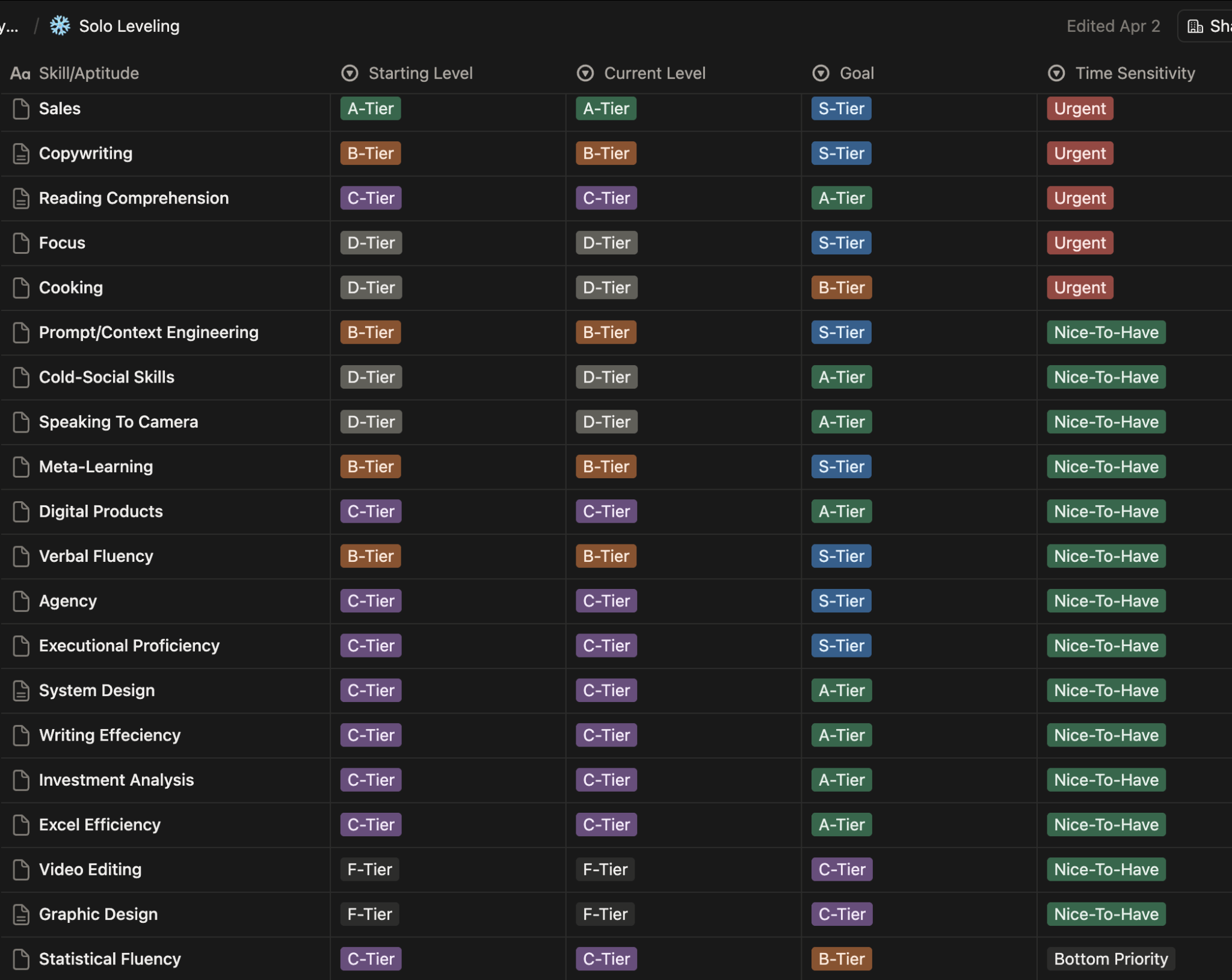
I need to configure my own weightages. I also needed to filter by how fast it needs to be learned, how it will be used, and what threshold I should reach before picking up something else.
How much should things be done for the sake of helping my future, as opposed to something benefiting me right now?
What is the right allocation of momentum plays and contrarian bets?
Large work in process, but I drafted up a notion table to organize these ideas
(ranking system was inspired by a popular anime I got around to watching).
It’s finally cool to start trying again
After jotting down my wishlist of skills/aptitudes to improve, most of it was FOMO.
But I didn’t really need to become an expert at everything. Does anyone play in the NBA, NFL, and MLB at the same time?
There’s still more narrowing to be done. Worst case: my whole strategy flops
I’ve accepted that some of my decisions may not even be reversible. But they aren’t definitive.
I could lose 5% on a stock, and it may never go back up. The money is permanently lost.
But something was broken about my process. There was something I overlooked, and the next time I catch it, my judgment grows stronger, not weaker.
Instead of measuring an exponential outcome, I’m acutely observing where I’m messing up and why. So the next time I find the “next big thing” and get back in the arena, I’m ready.
I’m not doing it from a place of insecurity but conviction.
My identity became too fragile around becoming a “successful bootstrapped founder”.
I could no longer stomach the vulnerability of finding evidence that I wasn’t as good as I really thought I was.
None of the productivity strategies, Parkinson’s law, or Pomodoro techniques could rattle me out of an identity problem.
Now that I have a broader view of what it means to have strength and make progress, I look forward to struggling a little more.
And try my best to experience life, instead of controlling it.
Thank you to the entire village of people who never let me sink, even when I wanted to.
(Planning to help build another startup from $0 -> $1M ARR in three months next summer, but saving that for next post… cause this one is already way too long).